
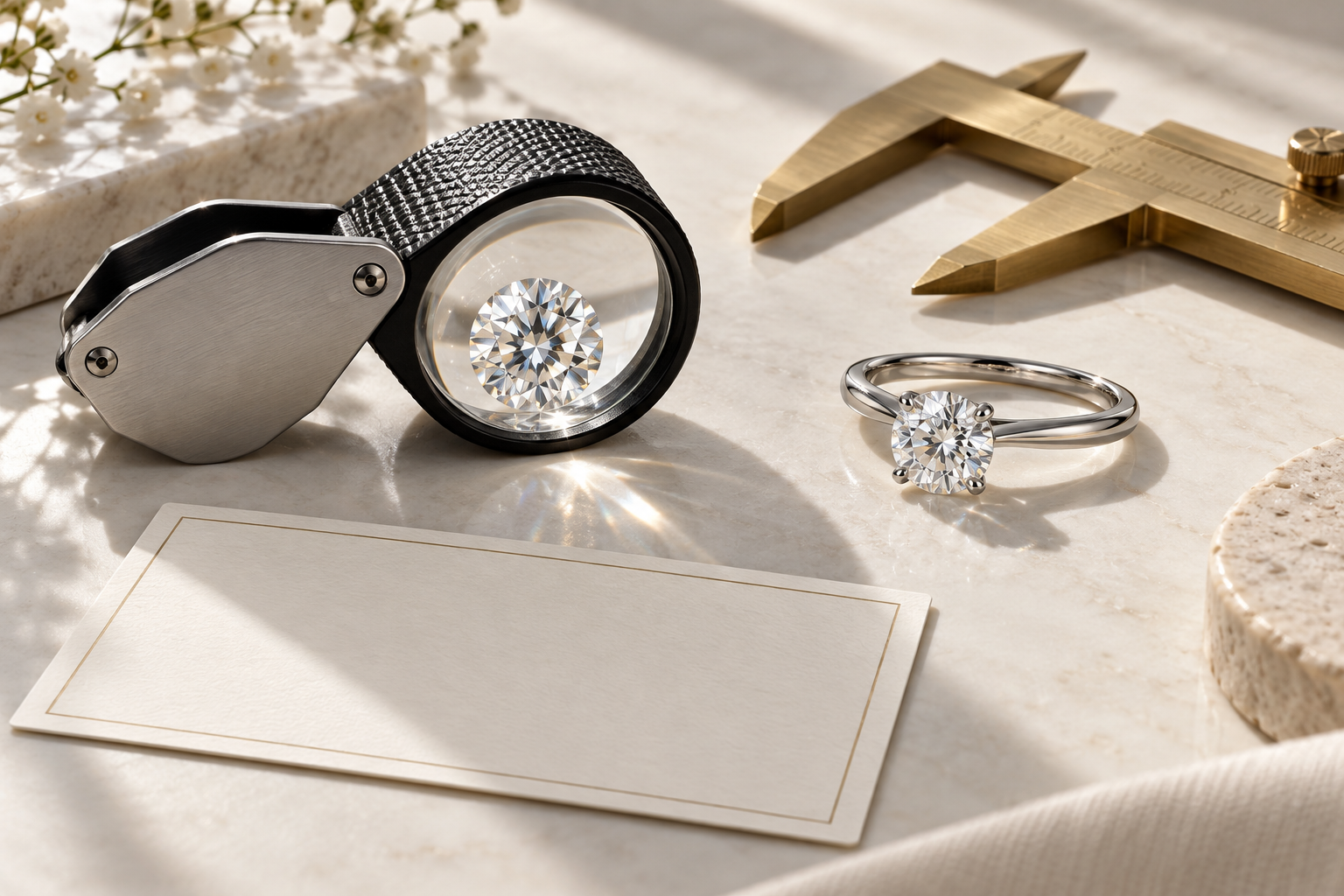
Diamond shopping can feel like a wall of numbers and abbreviations. A good starting point is to understand what those details describe, then compare pieces with the same kind of information. At i.Yuva, lab-grown diamond jewelry is the focus; the exact stone and setting specifications should be stated on each product page.
Start with the 4Cs
The 4Cs—cut, color, clarity, and carat weight—are widely used to describe diamond quality. The Gemological Institute of America (GIA) explains how the four characteristics describe a finished diamond. For round brilliant engagement rings, GIA also offers a detailed selection guide that connects the 4Cs with lighting, metal color, durability, and setting style. The 4Cs work together, so a higher grade in one category alone does not tell you whether a particular stone is the right choice for you.
- Cut: For a standard round brilliant, the cut grade evaluates how proportions, symmetry, and polish affect brightness, fire, and scintillation. Shape names the outline; cut describes how the facets work with light.
- Color: The degree of colorlessness described by a grading scale. A small change may be subtle once a stone is set.
- Clarity: Internal inclusions and surface blemishes are evaluated by their size, number, position, nature, and relief. A grade is assigned under magnification; ask to inspect the actual stone and report.
- Carat weight: The diamond's weight, not its face-up size by itself. Shape and proportions also affect how large it appears.
Choosing a round brilliant engagement diamond
GIA’s round-diamond guidance puts cut high on the shortlist because it shapes the stone’s brightness, colored flashes (fire), and sparkle as the diamond or light moves. A GIA cut grade is given for standard round brilliant diamonds, from Excellent to Poor; fancy shapes do not use this same cut-grade scale. Use the report as a starting point, then view the actual diamond if possible.
- Look in more than one kind of light. Bright spotlights can make many stones appear lively. Check the diamond in softer, diffuse light and in everyday lighting, too.
- Consider color with the setting. Metal color and surrounding stones affect the way a diamond appears. Compare the stone in the metal you plan to wear rather than choosing a grade in isolation.
- Judge clarity in context. Grades describe characteristics under controlled magnification, not necessarily what you will see unaided. For a set stone, ask about the location of inclusions and whether they affect the look or setting.
- Compare dimensions as well as carat. Carat is weight. Shape, proportions, and where weight sits can change face-up size, so review measurements and the actual stone.
Setting style also changes the look and everyday practicality of a ring. Prongs leave more of the stone exposed; a bezel surrounds its edge and can offer a smoother profile; elevated settings may stand out more but can catch on clothing. Ask your jeweller how the exact design protects the stone, how it is maintained, and whether resizing is possible for that setting.
Understand the diamond's origin
Lab-grown diamonds are diamonds created through a laboratory growth process. Natural diamonds form in the earth. Their origins differ, while both are diamond material; origin should be clearly disclosed rather than inferred from a photograph or price. Ask whether the center and accent stones are lab-grown or natural, and whether any non-diamond simulants are used.
For a lab-grown center stone, ask for the grading document or other identification supplied with that stone. Review the issuing laboratory, report number, stone description, measurements, 4Cs, and any origin or treatment statements. GIA's diamond buyer's guide describes its reporting for natural and laboratory-grown diamonds. A grading report describes a stone; it is not the same as an appraisal, a resale guarantee, or a promise of future value.
Compare complete pieces, not just one grade
When comparing two Indian listings, make sure you are comparing the same kind of item. Check whether the listed carat weight refers to the center stone or total diamond weight, whether the stone is loose or already set, and whether the metal and ring size are included in the displayed price. Also compare shape, dimensions, setting style, and the report details available for the exact stone.
For diamond jewelry, ask how the setting affects the stone's appearance and everyday wear. A well-described product page should make it clear what is included in the piece and what can be customized. If any specification is missing, get it in writing before placing an order.
Your pre-purchase checklist
- Confirm lab-grown or natural origin for the center and accent stones.
- Read the 4Cs, check what the carat figure represents, and compare the stone’s measurements.
- Ask for the grading-document details and the process for verifying the report number, where available.
- Confirm metal type, purity, ring size, final INR price, and any additional charges.
- Review the delivery estimate, resizing options, returns, and after-sales terms before payment.
i.Yuva's made-to-order model is designed around producing a piece in India after an order is placed. This can make clear product specifications and responsive guidance especially important: choose from the information shown for that specific design, and confirm any remaining details with i.Yuva before ordering.
Further reading
GIA: Diamond quality factors and the 4Cs
GIA: Diamond buyer's guide
GIA: How to select a round diamond engagement ring